Analytics-Con-301 Valid Test Test | Analytics-Con-301 Practice Exam Pdf
Wiki Article
P.S. Free 2026 Salesforce Analytics-Con-301 dumps are available on Google Drive shared by CramPDF: https://drive.google.com/open?id=15swjwEZ7p28sA3jBKI4oQwMc7AAhnclB
For candidates who are going to attend the exam, the pass rate may be an important consideration while choose the Analytics-Con-301 exam materials. With pass rate more than 98.75%, we can ensure you pass the exam successfully if you choose us. Analytics-Con-301 exam torrent will make your efforts pay off. We also pass guarantee and money back guarantee if you fail to pass the exam, and your money will be returned to your payment count. In addition, Analytics-Con-301 Study Materials provide you with free update for 365 days, and the update version will be sent to your email automatically.
Salesforce Analytics-Con-301 Exam Syllabus Topics:
| Topic | Details |
|---|---|
| Topic 1 |
|
| Topic 2 |
|
| Topic 3 |
|
>> Analytics-Con-301 Valid Test Test <<
Get a Free Demo of Salesforce Analytics-Con-301 Questions Before Purchase
We provide you with free update for one year for Analytics-Con-301 study guide, that is to say, there no need for you to spend extra money on update version. The update version for Analytics-Con-301 exam materials will be sent to your email automatically. In addition, Analytics-Con-301 exam dumps are compiled by experienced experts who are quite familiar with the exam center, therefore the quality can be guaranteed. You can use the Analytics-Con-301 Exam Materials at ease. We have online and offline service, and if you have any questions for Analytics-Con-301 training materials, don’t hesitate to consult us.
Salesforce Certified Tableau Consultant Sample Questions (Q54-Q59):
NEW QUESTION # 54
SIMULATION
From the desktop, open the CC workbook. Use the US Population Estimates data source.
You need to shape the data in US Population Estimates by using Tableau Desktop. The data must be formatted as shown in the following table.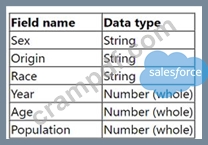
Open the Population worksheet. Enter the total number of records contained in the data set into the Total Records parameter.
From the File menu in Tableau Desktop, click Save.
Answer:
Explanation:
See the complete Steps below in Explanation
Explanation:
To shape the data in the "US Population Estimates" data source and enter the total number of records into the "Total Records" parameter in Tableau Desktop, follow these steps:
Open the CC Workbook and Access the Worksheet:
From the desktop, double-click on the CC workbook to open it in Tableau Desktop.
Navigate to the Population worksheet by selecting its tab at the bottom of the window.
Format and Shape the Data:
Ensure the data types match those specified in the requirements: Sex, Origin, Race as strings; Year, Age, Population as whole numbers.
To verify or change the data type, click on the dropdown arrow next to each field name in the Data pane and select "Change Data Type" if necessary.
Calculate Total Number of Records:
Create a new calculated field named "Total Records". To do this, right-click in the Data pane and select "Create Calculated Field".
Enter the formula COUNT([Record ID]) or SUM([Number of Records]) depending on how the data source identifies each row uniquely.
Drag this new calculated field onto the worksheet to display the total number of records.
Enter the Value into the Total Records Parameter:
Locate the "Total Records" parameter in the Data pane. Right-click on the parameter and select "Edit".
Manually enter the number displayed from the calculated field into the parameter, ensuring accuracy to meet the data shaping requirement.
Save Your Changes:
From the File menu, click 'Save' to ensure all your changes are stored.
References:
Tableau Desktop Guide: Provides detailed instructions on managing data types, creating calculated fields, and updating parameters.
Tableau Data Shaping Techniques: Outlines effective methods for manipulating and structuring data for analysis.
This process will ensure the data in the "US Population Estimates" is accurately shaped according to the specified format and that the total number of records is correctly calculated and entered into the designated parameter. This thorough approach ensures data integrity and accuracy in reporting.
NEW QUESTION # 55
A worksheet uses a LOOKUP function to display Sales by Month, Year of Order Date, and sales from the last
12 months. A consultant wants to use a Relative Date Filter to filter for data from the last 12 months.
However, when the consultant does this, the prior year's data is removed from the sheet.
Which two actions should the consultant take to retain the prior year's data after applying the filter? Choose two.
- A. Create the following calculation: LOOKUP(MIN([Order Date]),0). Filter on that calculation instead of Order Date.
- B. Create the following calculation: DATEDIFF('month', [Order Date], {MAX([Order Date])}) < 12. Hide all False values.
- C. Set the Relative Date filter as a Context Filter instead of Measure Filter.
- D. Replace the LOOKUP function with a FIXED Level of Detail (LOD) expression.
Answer: A,C
Explanation:
Comprehensive and Detailed Explanation From Exact Extract:
A LOOKUP table calculation requires access to rows outside the filtered date range so that the calculation can reference prior data. When a Relative Date Filter removes older data before the table calculation is evaluated, the LOOKUP loses the needed rows, causing the prior year's data to disappear.
Tableau's order of operations states:
* Relative Date Filters act early (at the dimension filter stage).
* Table calculations act very late.
* To preserve table calculation context, filters must not remove necessary rows.
Two Tableau-documented approaches address this:
Explanation for B
Setting the Relative Date Filter as a Context Filter allows table calculations to operate on the full dataset needed for LOOKUP. Context filters create a separate temporary table, and subsequent filters like table calculations evaluate after the context is established.
This ensures older rows are still available to the LOOKUP function.
Explanation for C
Creating a field such as:
LOOKUP(MIN([Order Date]), 0)
and filtering on this field instead of Order Date converts the filter into a table calculation filter, which occurs after the LOOKUP computation. Tableau documentation explains that table calculation filters preserve the full dataset required for the LOOKUP window.
This ensures that the LOOKUP still has access to last year's values even when filtering for the current 12 months.
Why A is incorrect
Replacing LOOKUP with an LOD changes the logic entirely.
LOD expressions cannot replicate moving-window or lag-type behavior.
Why D is incorrect
DATEDIFF logic can replicate a rolling window, but hiding False values is essentially a manual filter and does not preserve the integrity of the LOOKUP's required partitioning. It also contradicts Tableau's recommended approach for maintaining table calculation context.
* Tableau Order of Operations explaining why table calculation filters preserve data for LOOKUP.
* Tableau documentation on context filters and how they allow more data to remain available for downstream table calculations.
* Tableau guidance on how Relative Date Filters interact with table calculations.
* Best practices for preserving table calculation window rows when filtering.
NEW QUESTION # 56
A customer wants to leverage generative AI capabilities. The customer is currently on Tableau Server 2023.1.
How is the customer able to leverage generative AI in Tableau?
- A. Use a dashboard accelerator from Tableau Exchange.
- B. Perform API calls from Tableau Server to sandboxed extensions hosted by Tableau.
- C. Upgrade Tableau Server from 2023.1 to the latest version.
- D. Migrate Tableau Server to Tableau Cloud.
Answer: D
Explanation:
Comprehensive and Detailed Explanation From Exact Extract:
Tableau's official generative AI capability-Tableau Pulse and Einstein-powered Tableau AI features- are available only on Tableau Cloud, not Tableau Server.
Key Tableau facts:
* Tableau Server (any version, including new ones) does not provide generative AI capabilities.
* Tableau Cloud includes AI features such as:
* Tableau Pulse
* Einstein Copilot
* Natural language questions
* Automated insights
* Upgrading Tableau Server does not provide generative AI.
* Extensions and accelerators do not enable AI functionality.
Therefore, the customer must migrate from Tableau Server to Tableau Cloud to leverage generative AI.
* Tableau AI/Pulse documentation stating availability only in Tableau Cloud.
* Feature comparison charts showing generative AI unavailable on Tableau Server.
NEW QUESTION # 57
A client has a large data set that contains more than 10 million rows.
A consultant wants to calculate a profitability threshold as efficiently as possible. The calculation must classify the profits by using the following specifications:
. Classify profit margins above 50% as Highly Profitable.
. Classify profit margins between 0% and 50% as Profitable.
. Classify profit margins below 0% as Unprofitable.
Which calculation meets these requirements?
- A. IF [ProfitMargin]>0.50 Then 'Highly Profitable'
ELSEIF [ProfitMargin]>=0 Then 'Profitable'
ELSEIF [ProfitMargin] <0 Then 'Unprofitable'END - B. IF [ProfitMargin]>=0.50 Then 'Highly Profitable'
ELSEIF [ProfitMargin]>=0 Then 'Profitable'
ELSE 'Unprofitable'
END - C. IF([ProfitMargin]>=0.50,'Highly Profitable', 'Profitable')ELSE 'Unprofitable'END
- D. IF [ProfitMargin]>0.50 Then 'Highly Profitable'
ELSEIF [ProfitMargin]>=0 Then 'Profitable'
ELSE 'Unprofitable'
END
Answer: B
Explanation:
The correct calculation for classifying profit margins into categories based on specified thresholds involves the use of conditional statements that check ranges in a logical order:
* Highly Profitable Classification: The first condition checks if the profit margin is 50% or more. This must use the ">=" operator to include exactly 50% as "Highly Profitable".
* Profitable Classification: The next condition checks if the profit margin is between 0% and 50%.
Since any value falling at or above 50% is already classified, this condition only needs to check for values greater than or equal to 0%.
* Unprofitable Classification: The final condition captures any remaining scenarios, which would only be values less than 0%.
References:
Logical Order in Conditional Statements: It is crucial in programming and data calculation to ensure that conditions in IF statements are structured in a logical and non-overlapping manner to accurately categorize all possible values.
NEW QUESTION # 58
A customer plans to do an in-place upgrade of their single node Tableau Server from 2023.1 to the most recent version.
What is the correct sequence to prepare for an in-place upgrade?
- A. * In a non-production environment:
* Clone a copy of existing production environment to create a VM snapshot.
* Restore the VM snapshot into the non-production environment.
* Run the upgrade script for the most recent version of Tableau Server.
* Confirm everything works as expected and test new features.
* Redirect user traffic from the production environment to the non-production environment. - B. * In a non-production environment:
* Install the most recent version of Tableau Server.
* Back up the existing production environment.
* Restore settings and backup into the non-production environment.
* Confirm everything works as expected and test new features.
* Redirect user traffic from the production environment to the non-production environment. - C. * In the production environment:
* Disable scheduled tasks.
* Run the upgrade script for the most recent version of Tableau Server.
* Confirm everything works as expected and test new features. - D. * In the production environment:
* Disable scheduled tasks.
* Uninstall Tableau Server 2023.1.
* Run the upgrade script for the most recent version of Tableau Server.
* Confirm everything works as expected and test new features.
Answer: C
Explanation:
Tableau's official in-place upgrade steps for single-node Tableau Server require:
* Disable scheduled tasks (to prevent extract failures during upgrade).
* Run the upgrade script for the new version.
* Validate and test the server after upgrade.
The critical detail:
An in-place upgrade means upgrading the existing production environment directly, not installing in a separate environment or cloning VMs.
Option B matches exactly the documented operational steps for an in-place upgrade.
Why the other options are incorrect:
* A: Uninstalling Tableau Server is not part of an in-place upgrade workflow.
* C: This describes a migration or test upgrade in a separate environment, not an in-place upgrade.
* D: VM cloning and restoring is not required for in-place upgrades and is not part of Tableau's official procedure.
Only B represents the correct in-place upgrade sequence.
* Tableau Server in-place upgrade instructions: disable tasks # run upgrade script # test.
* Single-node upgrade guidelines noting that uninstalling is not required.
* Tableau Server administration materials clarifying the difference between in-place upgrade and sandbox testing.
NEW QUESTION # 59
......
With the furious competition of the society, our CramPDF still have a good reputation from candidates in IT exam certification, because we always develop our exam software in the examinees' stand. For instance, Analytics-Con-301 exam software with good sales is developed by our professional technical team with deep analysis of a lot of Analytics-Con-301 Exam Questions. Although we guarantee "No help, full refund", those who have purchased our products have pass the exam successfully, which shows the effectiveness and reliability of our Analytics-Con-301 exam software.
Analytics-Con-301 Practice Exam Pdf: https://www.crampdf.com/Analytics-Con-301-exam-prep-dumps.html
- New Analytics-Con-301 Dumps Files ???? Analytics-Con-301 Prepaway Dumps ???? Valid Analytics-Con-301 Test Sample ???? Enter ⇛ www.testkingpass.com ⇚ and search for { Analytics-Con-301 } to download for free ????Pass Analytics-Con-301 Guaranteed
- Analytics-Con-301 Valid Test Test: Salesforce Certified Tableau Consultant - Valid Salesforce Analytics-Con-301 Practice Exam Pdf ???? Download ⇛ Analytics-Con-301 ⇚ for free by simply searching on ⇛ www.pdfvce.com ⇚ ????Pass Analytics-Con-301 Guaranteed
- Analytics-Con-301 Quiz ???? Analytics-Con-301 Latest Exam Question ⏮ Analytics-Con-301 Pass Leader Dumps ???? Open ➤ www.troytecdumps.com ⮘ enter ➽ Analytics-Con-301 ???? and obtain a free download ????Reliable Analytics-Con-301 Exam Test
- Latest Analytics-Con-301 Exam Format ???? Analytics-Con-301 Exam Bible ???? Analytics-Con-301 Test Lab Questions ???? ➠ www.pdfvce.com ???? is best website to obtain ➤ Analytics-Con-301 ⮘ for free download ????Analytics-Con-301 Reliable Exam Price
- Analytics-Con-301 Test Lab Questions ???? Analytics-Con-301 Latest Exam Question ???? Valid Braindumps Analytics-Con-301 Ebook ???? Search for ⏩ Analytics-Con-301 ⏪ and download it for free on ⮆ www.prep4away.com ⮄ website ⬅Analytics-Con-301 Test Lab Questions
- Salesforce Analytics-Con-301 Exam Questions - Choice Of Certified Professionals [2026] ???? Search for { Analytics-Con-301 } and download exam materials for free through ➥ www.pdfvce.com ???? ✏Analytics-Con-301 Study Guides
- Analytics-Con-301 Exam Questions Preparation Material By www.vce4dumps.com ???? Search on ⮆ www.vce4dumps.com ⮄ for ➥ Analytics-Con-301 ???? to obtain exam materials for free download ????Analytics-Con-301 Study Guides
- Analytics-Con-301 Latest Exam Question ???? Valid Analytics-Con-301 Exam Answers ???? Valid Analytics-Con-301 Exam Answers ???? Open 「 www.pdfvce.com 」 enter ➤ Analytics-Con-301 ⮘ and obtain a free download ✊Valid Braindumps Analytics-Con-301 Ebook
- Analytics-Con-301 Study Guides ???? Pass Analytics-Con-301 Guaranteed ???? Analytics-Con-301 Practice Questions ???? ☀ www.pdfdumps.com ️☀️ is best website to obtain ➡ Analytics-Con-301 ️⬅️ for free download ????Analytics-Con-301 Quiz
- Reliable Analytics-Con-301 Exam Test ???? Analytics-Con-301 Study Guides ☎ New Analytics-Con-301 Dumps Files ???? Search for ▶ Analytics-Con-301 ◀ and easily obtain a free download on ⇛ www.pdfvce.com ⇚ ????Analytics-Con-301 Latest Exam Question
- Study Your Salesforce Analytics-Con-301 Exam with Pass-Sure Analytics-Con-301 Valid Test Test: Salesforce Certified Tableau Consultant Efficiently ???? Search for ➡ Analytics-Con-301 ️⬅️ and obtain a free download on 「 www.practicevce.com 」 ????New Analytics-Con-301 Dumps Files
- lucketg219923.prublogger.com, cyruswqyr817144.dreamyblogs.com, arranyliq485091.blogars.com, zaynmxgk495725.tusblogos.com, apollobookmarks.com, sahilvkqv437199.wiki-jp.com, amiednkt872403.blog-gold.com, madbookmarks.com, bookmarkcolumn.com, amberjwtn739365.snack-blog.com, Disposable vapes
DOWNLOAD the newest CramPDF Analytics-Con-301 PDF dumps from Cloud Storage for free: https://drive.google.com/open?id=15swjwEZ7p28sA3jBKI4oQwMc7AAhnclB
Report this wiki page